Pricing one holiday rental well is a part-time job. Pricing twenty is a full-time one. Where manual pricing breaks down at scale, and what changes when it is handled properly.
Pricing one holiday rental well is a part-time job. Pricing twenty well is a full-time one, and most portfolio managers are doing it in the gaps between check-ins, maintenance calls and owner updates. This piece looks at exactly where manual pricing breaks down at scale, and what changes when someone manages it properly.
The maths that catches up with you
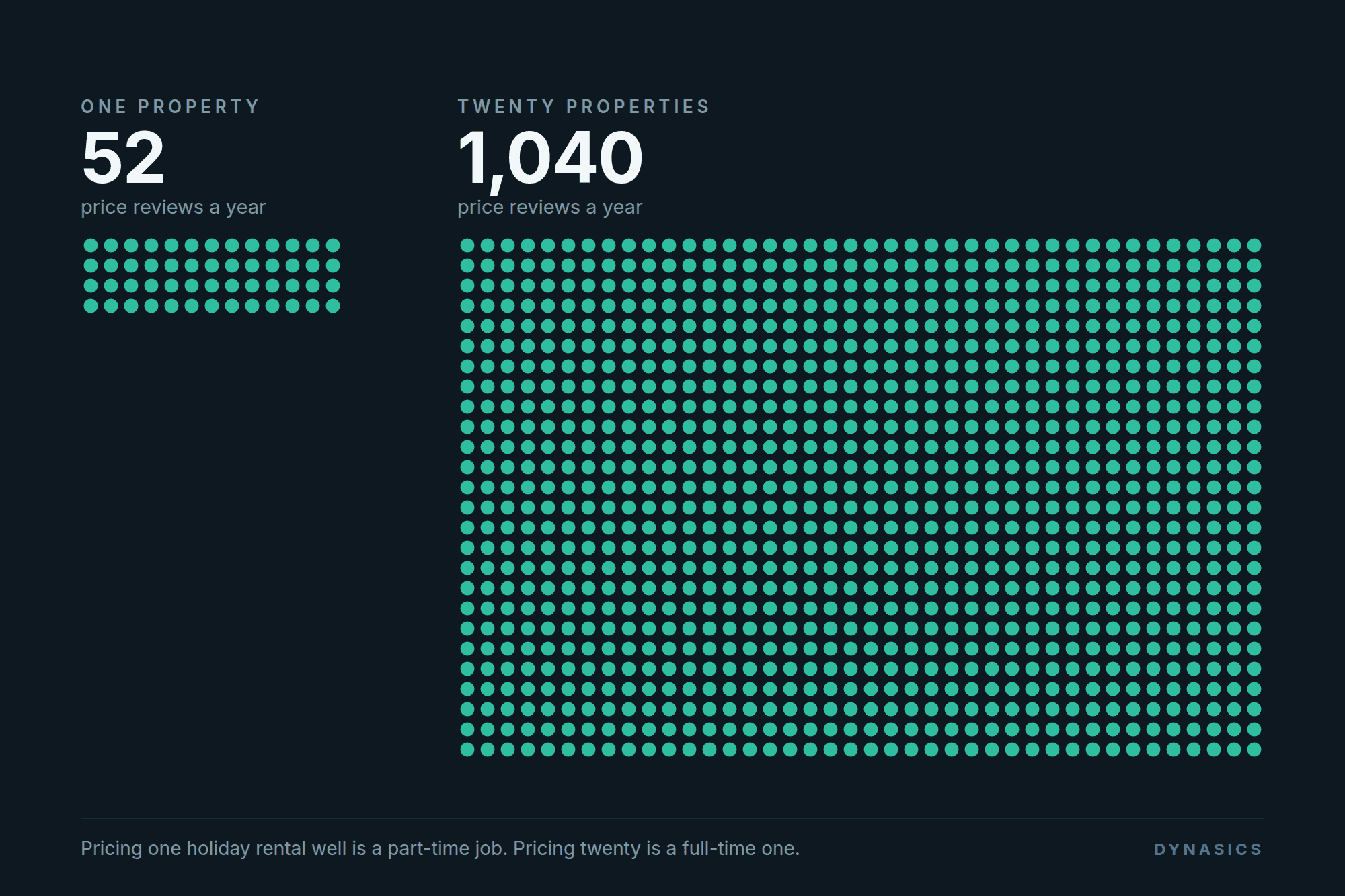
A single property owner who checks their rates once a week is doing something like 52 pricing reviews a year. That is manageable. It might even be enjoyable if you like watching your market.
Now scale it. Twenty properties, each with its own calendar, its own competitive set, its own booking pace. If you give each property the same weekly attention, you are doing over 1,000 pricing reviews a year. In practice, nobody does. What actually happens is that the portfolio gets priced in broad strokes: a summer rate, a winter rate, maybe a Christmas uplift, applied across groups of properties that are "similar enough."
That is not laziness. It is the only rational response to the workload. But it has a cost, and the cost compounds with every property you add.
Why "similar enough" properties are not priced similarly by the market
Two apartments in the same complex can have meaningfully different booking behaviour. One sleeps four and pulls families who book five months out. The other sleeps two and fills with couples booking three weeks ahead. Give them the same seasonal rate card and one of them is wrong most of the year. Usually both are, just in different directions.
Guests do not see your portfolio. They see one property, on one date, against everything else available for that date. The market prices at the level of the individual property and the individual night. A rate card built at the portfolio level cannot match that resolution, no matter how experienced the person who built it is.
The failures we see most often at scale
When we take on a portfolio, the same patterns show up again and again:
The strong performers subsidise the weak ones. A handful of properties book out early at rates that were set too low, which looks like success. The gap between what they earned and what they could have earned never appears on any report, so nobody misses it.
Shoulder seasons get a single blanket treatment. Peak weeks get attention because they matter and everyone knows it. The weeks either side of peak, where demand is real but uneven, get a flat discount off the summer rate. Those weeks are usually where the most recoverable revenue sits.
Rate changes lag events by weeks. A flight route gets cut, a local event lands on the calendar, a competitor drops prices for a quiet month. With one property you might notice within days. With twenty, the signal is buried under everything else the job demands, and by the time the rates move, the window has closed.
Minimum stays and gap nights go unmanaged. Orphan nights between bookings are a per-property, per-week problem. At portfolio scale they quietly add up to whole weeks of unsold inventory across the year.
None of these are knowledge problems. Most portfolio managers understand their market better than any outsider ever will. They are bandwidth problems, and bandwidth does not scale with experience.
What a managed approach actually changes
The obvious answer is software, and plenty of managers try it. A dynamic pricing platform will happily reprice twenty properties every day. The less obvious problem is that the platform now needs managing instead: base prices, seasonal profiles, minimum stay rules, event calendars, customisations per property, and a review cycle to catch the places where the algorithm's assumptions do not match your market. For a busy portfolio manager, this often just swaps one workload for another. It is a big part of why pricing tools get switched on, left on default settings, and quietly underperform.
A managed service changes the shape of the work rather than just the tooling. At Dynasics, we run the pricing platform, we build and maintain the per-property configuration, we watch booking pace and market movement, and we make the adjustments. The portfolio manager sets the guardrails that matter to them, minimum acceptable rates and any fixed-price or blocked dates, and everything above those floors is handled.
The practical difference for a 20-property portfolio:
Every property gets individual attention on every night of the calendar, not a shared rate card.
Market changes get a response in days, not at the next quarterly rate review.
Gap nights, minimum stays and last-minute windows are actively managed rather than left to defaults.
The manager's time goes back into the parts of the business that genuinely need a human on the ground: owners, guests, and growth.
What this looks like in the numbers
The stakes per property are well documented. Sykes Holiday Cottages' Holiday Letting Outlook Report 2026, drawing on data from more than 23,500 UK rentals, puts the average UK holiday let's gross income at £25,600 for 2025, up from £24,700 the year before. A 15 to 20% pricing gap on that average is £4,000 to £5,000 per property per year. Across twenty properties, the arithmetic stops being academic. Meanwhile the competitive backdrop is getting harder, not easier: AirDNA's European market reviews through late 2025 and early 2026 show listings supply continuing to grow ahead of demand, with Europe passing 4 million active listings, which means every poorly priced night faces more alternatives than it did a year ago.
Across the portfolios we manage, clients have averaged a year-on-year revenue uplift of around 21%. That figure is based on Dynasics customer data from 2025 to 2026, measured across managed portfolios against their own prior-year performance, and it includes cleaning fees but excludes taxes. Individual results vary with market conditions, property mix and starting point, and a portfolio that was already priced aggressively will see less headroom than one running on a static rate card.
The more honest way to think about it: the uplift is not magic. It is simply what happens when every night on every calendar gets priced deliberately instead of approximately. At one property the difference is real but modest. Across twenty, it is usually the margin between a good year and a very good one.
The questions worth asking about your own portfolio
If you manage multiple properties and want a quick self-diagnosis, these three questions do most of the work:
When did each property last have its rates changed individually, rather than as part of a group update? If the answer is "at the last seasonal review," there is almost certainly money being left behind.
Do you know which of your properties is furthest below its market rate right now? Not a feeling, an actual answer. Most managers cannot say, and that is completely normal. It is also the gap a dedicated pricing function closes.
How many hours a month does pricing actually get? Be honest about it. Then ask whether those hours are the best use of your time, given everything else the portfolio needs from you.
Where to go from here
Portfolio pricing does not break because managers lack skill. It breaks because the job quietly becomes too big to do well alongside everything else, and because the tools that promise to fix it come with their own workload attached.
Dynasics is a fully managed pricing service. There is no platform for you to learn and no dashboard you are expected to log into. We charge 1% of monthly booking revenue, with no setup fee and a rolling monthly agreement you can end with 30 days' notice.
If you manage a portfolio and want to know what your numbers could look like with every night priced properly, book a free consultation and we will walk through it with your actual properties, not hypotheticals.
